A middle school science teacher I know spent three years fighting the same battle every lesson: getting students to actually read the assigned material before class. She tried different assignments, different incentives, different ways of explaining why it mattered. Some students came prepared. Most arrived having skimmed at best, and the first twenty minutes of every class went to covering ground that should have been covered before anyone walked in.
Then her district piloted an educational app with interactive pre-reading modules not text with comprehension questions, but animated explanations, embedded short-answer prompts, and a simple activity that required students to make a prediction before seeing the answer. Completion rates for pre-class preparation went from roughly forty percent to above eighty percent within a month. The first twenty minutes of class changed entirely students arrived with questions, with things they’d found confusing, with competing predictions they wanted to test against each other.
The content hadn’t changed. The experience of engaging with it had, and that experience change was the difference between students who arrived prepared and students who arrived guessing. A thoughtful Education app development company understands that student engagement isn’t a motivation problem to be solved with rewards and gamification points. It’s a design problem that requires understanding how attention, curiosity, and feedback loops actually work for learning, and then building experiences around those mechanisms rather than around the convenience of content delivery.
The Attention Problem That Passive Content Can’t Solve
Digital content has an engagement paradox. Students have more access to information than any previous generation, and they’re demonstrably less likely to read or watch it attentively than students who had fewer alternatives. The reason is partly competition for attention and partly the passive consumption habit that years of scrollable, skippable content has embedded.
Educational apps that are genuinely engaging break the passive consumption pattern by making the student’s active response part of the learning experience rather than an optional add-on. The science teacher’s pre-reading modules worked not because they were more entertaining than a textbook but because they required students to do something predict, respond, choose rather than receive.
Active processing of information improves retention significantly compared to passive exposure, and this is one of the more robust findings in learning science. An app that builds active processing into the content experience requiring students to retrieve information rather than just see it, to apply concepts rather than just read about them, to explain something in their own words rather than recognise the correct answer from a list produces more learning from the same amount of time than an app that delivers the same content passively.
Building this kind of active engagement into digital content requires more design work than building a video or a slide deck. It requires thinking through the specific response that would indicate genuine understanding, designing the interaction that elicits that response, and building the feedback mechanism that makes the response feel meaningful rather than performative. These design decisions aren’t primarily technical they’re pedagogical, and they require educational expertise alongside engineering expertise to get right.
Feedback That Arrives When It Can Actually Change Behavior
One of the most consistent findings in educational research is that feedback is most effective when it arrives immediately after the response it’s addressing, while the student’s thinking is still accessible to them. A teacher who grades an essay two weeks after it was written is providing feedback on thinking that the student can barely reconstruct. A system that responds to a student’s answer within seconds is responding while the student’s reasoning is still present.
Educational apps make immediate feedback possible at a scale that no human teacher can match across thirty students simultaneously. When a student gets a math problem wrong, the app can respond immediately with a specific explanation of where the reasoning went astray not a generic “incorrect, try again” but a response calibrated to the specific error the student made. When a student misunderstands a concept, the app can provide a different explanation approach in real time rather than waiting for the teacher to identify the misunderstanding, formulate a response, and find the moment in the lesson to address it.
The specificity of feedback matters as much as its immediacy. Generic feedback “that’s not quite right” or “good job” produces less learning improvement than specific feedback that explains what was wrong or what made an answer correct. Building feedback systems that can distinguish between types of errors and respond specifically to each requires both content expertise in the subject area and technical infrastructure to store and pattern-match against common error types.
Progress Visibility That Motivates Rather Than Discourages
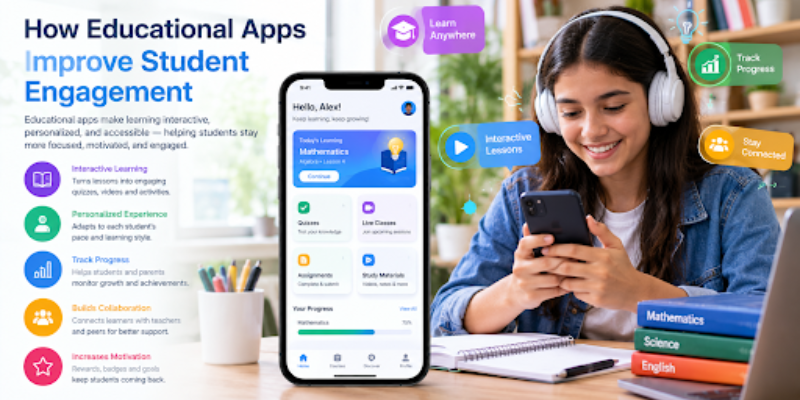
Students who can see their own progress not just their current grade but the trajectory of their improvement over time engage differently with learning than students who only see point-in-time assessments. The student who scored sixty percent on a quiz but can see they’ve improved fifteen points since the unit started has a different relationship with the material than the student who only knows they scored sixty percent.
Visualising progress in ways that feel genuinely meaningful rather than decorative is harder than it looks. A progress bar that fills as lessons are completed is visible but doesn’t tell a student what they actually know or where they’re improving. Skill maps that show which concepts have been mastered and which are still developing give students actionable information about where to focus. Learning streak indicators that track consistency of engagement rather than just volume of work reward the habit formation that sustains learning over time rather than just the performance spikes around deadlines.
The most sophisticated educational apps have moved toward mastery-based progress indicators not “you’ve completed unit three” but “you’ve demonstrated understanding of these specific concepts at this level of reliability.” This framing changes how students relate to their progress because it’s specific enough to be meaningful and flexible enough to reflect actual learning rather than time-on-platform.
Personalisation That Accounts for How Different Students Learn
A classroom of thirty students is thirty different learners with different prior knowledge, different processing speeds, different ways of making sense of new information, and different points where they get stuck. Traditional instruction addresses this inadequately because the logistics of thirty simultaneous learners constrain how much a teacher can adapt in real time.
Apps that personalise the learning path detecting where a student is struggling and adjusting the sequence, pacing, or explanation approach accordingly give each student an experience calibrated to where they actually are rather than where the curriculum assumes they should be. A student who has mastered a concept doesn’t benefit from reviewing it repeatedly. A student who hasn’t mastered a prerequisite concept doesn’t benefit from moving on to the concept that builds on it. Personalisation that respects where each student actually is produces better outcomes than uniform pacing.
The data that makes personalisation meaningful accumulates over time, which means apps that personalise well get better at it the longer a student uses them. A system that’s seen a student’s response patterns across fifty learning interactions has more signal to work with than one that’s seen five. Building the data model that captures the right information to power personalisation not just right or wrong answers but response time, pattern of errors, engagement duration, which explanation approaches precede successful responses is the technical foundation that personalisation depends on.
Where the Most Interesting Student Engagement Ideas Are Coming From
Among the mobile app ideas in education showing genuine engagement results rather than just novelty, a few directions have produced evidence worth paying attention to.
Peer explanation features where students record a brief video or audio explanation of a concept they’ve just learned, which other students can watch leverage the well-documented learning benefit of teaching as a way of consolidating understanding. The student who explains a concept consolidates their own understanding of it. The student who watches gets a peer perspective that complements the primary instruction. The app infrastructure required for this is modest. The engagement and learning benefits are documented enough in educational research that it’s surprising more apps don’t build it.
Curiosity-driven exploration modules that let students follow genuine questions if you’ve understood this concept and want to know why it works that way, here’s where to go next produce engagement from students who are ready to move beyond the curriculum’s pacing. Gifted students and highly motivated learners are frequently under-served by content that’s calibrated to the average, and apps that create pathways for exploration beyond the standard sequence keep these students engaged in ways that linear curriculum doesn’t.
Competition calibrated to appropriate peers not the full class leaderboard that demotivates struggling students and produces anxiety in high achievers, but small-group competitions between students at similar performance levels creates competitive engagement without the social dynamics that class-wide competition produces. The technical requirement is a matching system that groups students appropriately, which is non-trivial but manageable with the performance data apps accumulate during normal use.
The Science Teacher’s Next Problem
After the pre-class preparation problem was solved, she had a better problem: students arriving to class with more questions and more genuine curiosity than she’d planned for. Her lessons changed because the starting point of her students had changed.
She describes it as the app having done the work of creating genuine curiosity, which allowed her to do the work she was actually trained for deepening understanding, addressing the interesting confusions, helping students connect new knowledge to things they already knew. The app didn’t teach her students. It made them ready to be taught, which turned out to be a larger fraction of the teaching problem than she’d realized before it was solved.
That’s the engagement transformation that educational apps produce at their best. Not replacing the teacher’s role but changing what that role needs to do, by handling the preparation and initial curiosity-generation that frees classroom time for the kinds of learning interactions that only happen between a skilled teacher and a student who’s ready for them.